


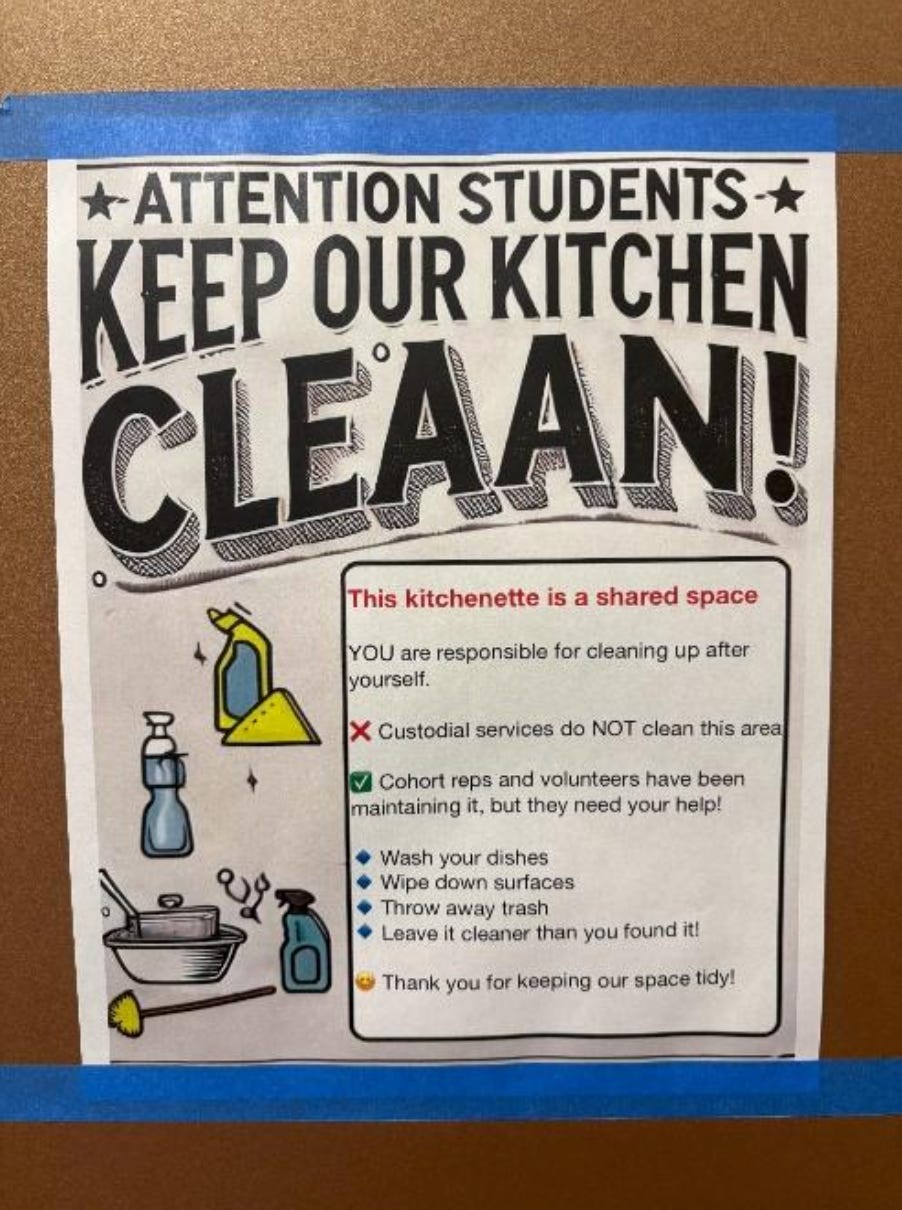
A poster in the Hariri building student lounge caught my eye last semester—a basic spelling error on display at an institution that prizes intellectual excellence. It’s a small thing (maybe), but once I noticed one iteration of carelessness, I started seeing it everywhere.
I call it slop: anything created without respect for the end-user. It’s not about price—Icebreakers gum delivers thoughtful utility in durable packaging at low cost, while premium Rosslyn apartments charge high-rent while offering brick wall views. It’s not about speed either—some fast-casual restaurants operate beautifully, while McMansion Hell chronicles the grotesque results of slow, meticulous construction across suburban America. Slop is a distinct lack of care woven into products, services, presentations, and content.
The puzzle is this: slop shouldn’t exist in a free market. Consumers should reject substandard goods; producers shouldn’t want to deliver them. So why does slop not only persist but proliferate?
The Business Case for Slop
Customers today differ profoundly from those of even a decade ago, shaped by two converging forces: economic habits and social fragmentation.
American household debt has surged 55% in ten years, reaching $18.39 trillion. Credit card accounts have increased 50% while the population grew only 6.4%. We’re more willing than ever to consume now and pay later—if at all. Meanwhile, 29% of households are single-person, double the rate from 65 years ago. Roughly half of U.S. adults report loneliness, with the highest rates among young adults. This erosion of connection has consequences: trust in others has dropped from 45% in 1972 to 30% in 2016. We’ve replaced traditional support systems with streaming services, doom scrolling, and YouTube rabbit holes.
These shifts create what Thorstein Veblen called “the leisure class”—consumers who prioritize conspicuous consumption and visible non-productive time. This changing customer has allowed four forces to build and sustain markets for slop.
Logo culture dominates modern marketing. Products aren’t sold on quality or materials; they’re sold on status. When did you last see an ad highlighting shirt stitching? Financial services don’t promote claims processing rates—they promote mascots. Capital One has “the Capital One Bank Guy”; Geico has “The Geico Gecko”; State Farm boasts “Jake from State Farm”. Advertising moves metrics, so firms treat it as investment. Strong brands obscure weak products.
Social proof has migrated from the backyard fence to the online feed. Decisions that were once binary have grown in complexity to account for hundreds of alternatives, supported by thousands of reviews. This data overload induces analysis paralysis, leading to simplification: consumers look for a 5-star rating and conclude “if it’s good enough for them, it’s good enough for me.” I’ve seen expectant mothers copy and paste an entire registry. Tim Wu calls this the “Tyranny of Convenience”—homogeneity masquerading as choice.
Price sensitivity trumps all other values. Half of U.S. consumers consider price the most important purchasing factor. And we’ve abandoned Maslow’s hierarchy: 82% of Americans aged 19-34 have health insurance, but 90% subscribe to a streaming service that has less impact on their bottom line. We’re looking more closely at the price tag than we are at the product.
Technology sustains slop through three mechanisms. First, specialization turns everyday objects into black boxes we can’t evaluate—I don’t know how my phone works, and manufacturers hide complexity behind screens. This creates information asymmetry ripe for adverse selection. Second, online shopping eliminates tactile evaluation and interpersonal cues while making returns inconvenient—58% of shoppers keep unwanted items to avoid the hassle of returns. This “cheap-and-easy” equilibrium lets low-cost producers scale while “buy it for life” remains niche. Third, and most powerfully, social media monetizes attention. Engagement-driven models reward novelty, outrage, and clickbait regardless of enduring value. As Edward Tufte observed, only two industries call their customers “users”: illegal drugs and software.
Slop at Scale
For those of us committed to fixing the problem, things will get worse before they get better. Within months, we’ll experience what Adobe calls “personalization at scale”. A sneaker commercial that is universally today will soon be rendered hundreds of ways for different micro-segments. This will make effective advertising even more effective, perpetuating slop through fractured communities, increased leisure appetite, and information asymmetry.
More troubling: the sheer volume of AI-generated content will usher in “the age of digital doubt.” For the first time, people will justifiably question the authenticity of what they see online. Forty-two percent of adults have already fallen for entirely false articles. When we can’t establish shared reality, how do we hold civic discourse? How do we make data-driven decisions?
This isn’t dystopian speculation. It’s where current trends lead.
Three Forces to Counter Slop at Scale
Litigation and legislation. Copyright lawsuits against AI companies are active and multiplying. U.S. copyright law still requires a human actor, creating opportunity to establish rigid structures for AI’s future. Legislation protecting consumers from deepfake manipulation and requiring disclosure of AI-generated content—like the European Union AI Act—can re-establish shared reality.
A return to humanism. As automation spreads, the business case for local, authentic goods and services will grow. Being able to tell a story about a hand-carved sofa from the 1970s will demand a higher willingness to pay than it will today. As Matthew Crawford wrote in Shop Class as Soulcraft, skilled tradespeople have something irreplaceable: “the building stands, the car now runs, the lights are on.”
Logging off. People will deliberately choose to log off as digital fragmentation drives them toward authentic relationships in school, work, and community. This may explain rising church attendance among Gen Z men despite no increase in religious affiliation—they’re seeking connection, not necessarily conviction.
What We Can Do
We’ll continue encountering slop. To safeguard our time, trust, and finances, we need an action plan.
Limit marketing exposure. Americans see 4,000-10,000 ads daily—more than any culture in history. That marketing will soon increase in effectiveness. Conduct a financial audit to track purchases prompted by advertising. Use that baseline to curb impulse buys.
Develop a consumption philosophy. Define what you value—where to indulge, economize, and avoid. When every dollar in your budget has a purpose, slop purchases become exceptions, not defaults.
Notice your environment. Exercise the muscle of observation. As you run errands, look at products, buildings, billboards—how well do offerings serve end-users? This sharpens your ability to avoid “good enough” slop.
For businesses, the opportunity is clear: use technology to strengthen human relationships, not replace them. Imagine AI that lets children hear stories in a grandparent’s voice, or AI-assisted urban design helping towns revive main streets. Maintain moments where craft and care are visible—there’s enduring demand for experiences made by people. Trader Joe’s exclusively uses employee checkout with no plans to automate, codifying their commitment to human connection. While not universally applicable, the principle matters: efficiency at the expense of health, productivity, and quality of life is not an objective good.
Finally, stop humanizing AI. Systems should not have names or be called “companions” or “assistants”—they’re language models. ChatGPT shouldn’t have a “thinking” caption because it isn’t thinking; it’s processing. Precision in terminology reduces hype and places technology in proper cultural context.
If this sounds pessimistic, that’s not my intent. But urgency is appropriate given the speed at which slop permeates our culture. This week, many people are excitedly downloading the latest app—a decision I’d liken to lighting that first cigarette, blissfully unaware of compounding consequences.
Slop has always existed, but shifting demographics, incentives, and technologies have increased its prevalence. Progress will come from disciplined consumption, designs that make quality observable, and business models that prize human connection alongside efficiency. Recommitting to objective truth, personal discipline, and community norms is how we move the market back toward durable value.
Together, we will stop the slop.
